When Pain Knocks and Suffering Answers
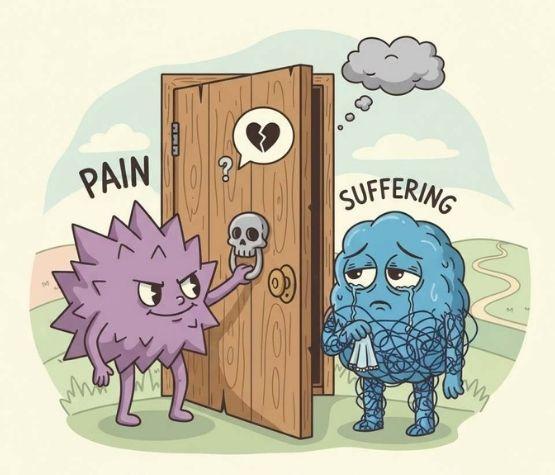
There is a quiet but powerful idea in psychology: pain and suffering are not the same. Pain is the emotion we feel when life doesn’t go as we hoped, when relationships end, when trust breaks, when loss arrives suddenly or slowly. It is the raw, honest experience of being human. Pain shows up as sadness, longing, anger, grief, or fear. It is uncomfortable, often intense, but it is direct and grounded in reality. Pain asks for presence. It invites us to acknowledge what mattered, to sit with our experience, and to allow space for healing to begin.
Suffering, however, is what happens when we fear or resist pain. Instead of allowing emotions to move through us, we fight them, analyze them, or avoid them. The mind clings to old conversations, replaying moments in search of answers. We check an ex-partner’s profile hoping to ease the ache, or we question what we could have done differently. We hold onto anger because it feels safer than vulnerability, or we numb ourselves because feeling deeply feels dangerous. Suffering is not weakness; it is an instinctive attempt to protect ourselves from emotional overwhelm.
Pain as a Natural Response
Pain is what we experience when something meaningful shifts or ends. It is clean, direct, and tied to reality. Pain is the heart acknowledging, “This mattered to me.” When we allow pain to be felt, it follows a natural curve: it rises, it settles, and over time it softens. Pain pushes us toward acceptance, reflection, and eventual integration. It can even deepen our capacity for empathy and insight.
This kind of emotional experience is not a sign something is wrong but it is a sign something mattered. Pain asks for stillness and honesty. It asks us to stay with our feelings long enough to understand them, rather than desperately trying to escape them.
Suffering as the Struggle Against Pain
Suffering is pain plus resistance. It is the loop of trying to undo what already happened, the mental wrestling with reality, and the search for control in something that cannot be controlled. We don’t suffer because we feel too deeply, we suffer because we are trying not to feel at all. These behaviors, whether it is checking a phone obsessively or replaying memories late at night, often feel protective in the moment. They give us a temporary illusion of connection, clarity, or control.
But suffering does not protect us; it suspends us. It keeps us living in the past, holding on to what is already gone. What could have been a wound that slowly healed becomes a cycle that keeps us stuck. Suffering exhausts us emotionally because we are constantly trying to outrun our own feelings.
Why We Slip Into Suffering
No one wakes up and decides to suffer. We slip into it because the nervous system associates certain behaviors with safety. Searching for answers feels like control. Staying angry feels like strength. Closing ourselves off from love feels like protection. Suffering is the mind’s way of saying, “I am afraid to feel this fully.” It is self-protection, but it is protection through avoidance rather than through processing and integration.
Understanding this softens judgment. Instead of saying, “Why can’t I just get over this?” we begin to see the underlying truth: “I am trying to protect myself because I am hurting.”
The Moment Healing Begins
Healing does not start when pain disappears. It begins when we stop resisting pain. This does not mean drowning in emotion or collapsing under it. It means allowing our feelings to exist without trying to fight, fix, or rush them. It means saying, “This hurts, and that makes sense.” When we stop battling our reality, the nervous system settles. The mental loops quiet. The heart, no longer being argued with, begins to release its tension.
Pain transforms when it is experienced fully and safely. The moment we become willing to feel our feelings, we stop feeding our suffering.
Choosing Trust in the Emotional Process
Healing does not ask us to erase memories, forget people, or pretend nothing mattered. It asks us to carry our experiences with honesty and compassion. Pain becomes a teacher rather than an enemy. We learn to miss someone without chasing them, to remember without reopening the wound, and to feel without collapsing into fear.
We move forward not by shutting down, but by trusting that we can feel deeply and still remain intact. Moving on is not about going back to who we were before; it is about becoming someone who can hold what happened without being held back by it.
Becoming Through What We Feel
The true difference between pain and suffering is not about strength; it is about surrender. Pain asks to be acknowledged. Suffering demands that we keep arguing with what is already real. When we stop resisting and start feeling, we begin to grow again. Pain becomes part of our evolution, not something that ruins us, but something that reshapes us gently, slowly, and honestly.
In the end, healing is not about avoiding heartbreak; it is about learning that a heart can break and still expand. Pain passes when allowed. Suffering fades when we stop feeding it. And slowly, we become someone softer, wiser, and more grounded than we ever knew we could be.