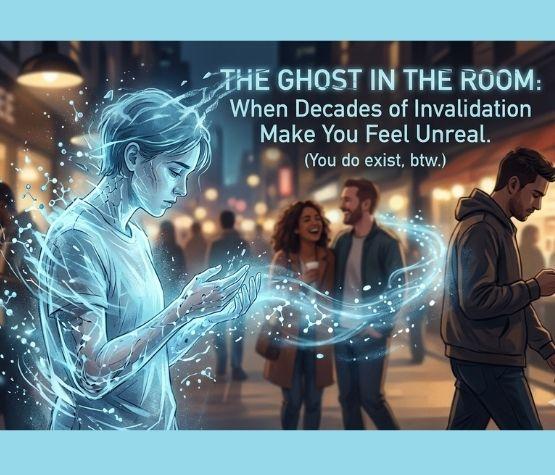
The Ghost in the Room: When Decades of Invalidation Make You Feel Unreal
There is a specific, eerie brand of trauma that doesn’t always involve loud noises or visible scars. It’s a quiet, "quasi-dissociative" state where you find yourself staring in the mirror or sitting at a dinner table, suddenly struck by a terrifying question: “Wait... do I even exist?”
If you’ve ever felt like a background character in your own life—or worse, like a glitch in the simulation—you aren’t losing your mind. You are experiencing the long-term physiological fallout of systematic invalidation.
The Architecture of Erasure
Humans are social creatures; we mirror ourselves through the eyes of those we love. When the "important people" in your life—parents, partners, or mentors—consistently ignore your needs, talk over your feelings, or treat your presence as a mere convenience, they are performing a form of psychological erasure.
After decades of this, your brain does something "logical" but devastating: It stops registering its own presence. If the world acts like you aren't there, your nervous system begins to agree. This isn't just a "feeling"; it's a defensive detachment known as depersonalization.
Why We "Fade Out"
This quasi-dissociative state is actually a survival mechanism. When your environment is consistently dismissive or hostile, "checking out" of your own existence protects you from the pain of being rejected.
- The Emotional Mute Button: If your feelings are never validated, you stop feeling them to save energy.
- The Observer Effect: You begin to watch your life happen from a distance, like a movie you aren't particularly interested in.
- The Body-Mind Gap: You might feel "floaty," or like your limbs don't quite belong to you.
How to "Anchor" Yourself Back to Earth
Healing from decades of being "unseen" requires more than just positive thinking. It requires somatic (body-based) proof that you are here.
- The 5-4-3-2-1 Technique: Focus on 5 things you see, 4 you can touch, 3 you hear, 2 you smell, and 1 you can taste. This forces your brain to acknowledge your physical interface with the world.
- Proprioceptive Input: Push your hands hard against a wall or wrap yourself in a weighted blanket. The physical pressure sends a signal to your brain: "There is a boundary here. I end, and the world begins."
- Mirror Work (The Hard Part): Look at yourself in the mirror and say your name out loud. It feels "weird" because you're reclaiming space that was previously left vacant.
The Comparison: Invalidation vs. Presence
Invalidation often leaves you feeling like a ghost—transparent, unseen, and unsure of your own reality. You may begin to doubt your memories and perceptions, hesitate to speak or act without permission, and experience a sense of dissociation or emotional numbness. In contrast, the experience of presence feels grounding and real—you feel “weighted,” solid in who you are. You trust your felt sense of situations, take up space as your natural right, and allow yourself to be emotionally responsive, even if that includes the messy, imperfect parts of being human.
A Necessary Reminder
If you are reading this, your heart is beating. Your lungs are moving air. Your perspective—however fragmented it feels right now—is unique and irreplaceable.
You weren't invisible; you were just surrounded by people who were blind to your value. Their inability to see you was a reflection of their limitations, not a commentary on your reality.
You do exist. You are not a ghost; you are a person who has survived being treated like one.