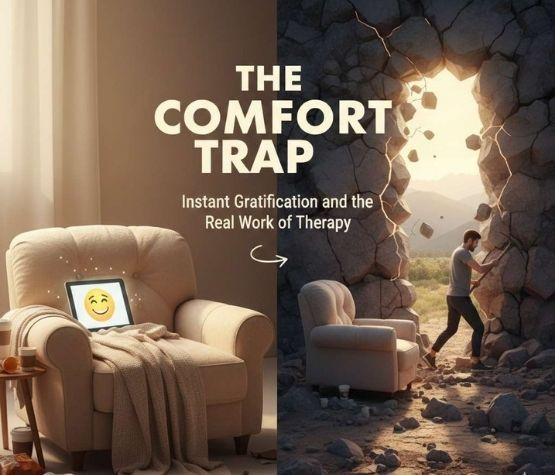
The Comfort Trap: Instant Gratification and the Real Work of Therapy
We live in a world built on speed. Almost everything we want arrives instantly: food, entertainment, information, conversations, solutions. With a single tap, we satisfy cravings, distract ourselves from discomfort, or escape difficult emotions. This culture of instant gratification has slowly shaped the way people approach mental health as well. Many now look for relief the same way they look for anything else—quickly, easily and without resistance.
But real therapy works in the opposite direction. And this creates a tension that is quietly reshaping the emotional landscape of an entire generation.
The Seduction of Immediate Relief
Instant gratification feels good because it removes discomfort immediately. A long day can be erased with a reel, a notification, a chat, a distraction. When emotions rise, the first instinct is not to sit with them, but to silence them. Pain is no longer something to understand; it’s something to mute.
This habit spills over into emotional struggles. When someone feels anxious or overwhelmed, their reflex is to find the fastest escape. It could be scrolling endlessly, venting to a chatbot, overthinking, binge-watching or retreating into anything that feels soothing in the moment. The relief is real, but temporary. The feeling goes away, but nothing truly changes.
The mind learns that emotional discomfort is unsafe, and that the goal is not to feel but to flee. Over time, people lose the ability to tolerate heavy emotions. They become experts at coping, but not healing.
Therapy Asks for What Instant Gratification Avoids
Real therapy requires patience, discomfort, and honesty. It asks you to do something the world has slowly untrained us to do: sit with feelings. Therapy requires you to talk about memories you spent years avoiding, question beliefs you’ve always carried, and look at parts of yourself you don’t want to see. It invites you into slow work, not fast relief.
This is difficult in a culture where slowness feels like failure. People expect therapy to feel like a soothing conversation, when in reality, it often feels like emotional detox. It brings buried emotions to the surface, sometimes making things feel heavier before they get lighter. To someone conditioned by instant gratification, this feels wrong. They assume the therapy isn’t working, when in fact, this is exactly where the work begins.
When Quick Fixes Masquerade as Healing
Because people dislike discomfort, many start seeking “therapy substitutes” that provide emotional ease without emotional growth. Inspirational quotes, mental health reels, self-diagnosis content, AI therapy apps and comforting online communities all feel therapeutic but rarely create real change. They offer validation, not transformation. They soothe the pain but do not touch its root.
The danger is subtle. If people believe these temporary comforts are actual healing, they stop seeking the deeper work. They feel emotionally supported but remain in the same patterns, carrying the same wounds.
The Deep Work the Screen Cannot Do
Therapy is about more than talking. It is about understanding your patterns, challenging your defences, sitting with your discomfort and building emotional endurance. It is slow, repetitive, sometimes frustrating work. But it creates lasting change because it rewires the way you respond to the world.
Instant gratification removes stress in seconds. Therapy teaches you how to live without running from it. Instant gratification distracts. Therapy reveals. Instant gratification soothes pain. Therapy transforms it. One gives comfort. The other builds strength.
Choosing Growth Over Relief
We need both comfort and growth, but in the right order. Comfort may calm the mind, but growth frees it. Healing requires a willingness to sit inside uncomfortable emotions long enough to understand them. It asks for patience in a world that celebrates speed. And it asks for depth in a world that survives on surfaces.
The real difference between instant gratification and therapy is this: one helps you avoid yourself, and the other brings you back to yourself. Learning to choose the slower path may feel unnatural at first, but it is the only path that leads to real emotional freedom.